
Introduction
Pilot training is a dream for many students, but it is also one of the biggest financial decisions in aviation education. Before joining any flying school, students and parents should clearly understand the cost difference between SPL, PPL, and CPL.
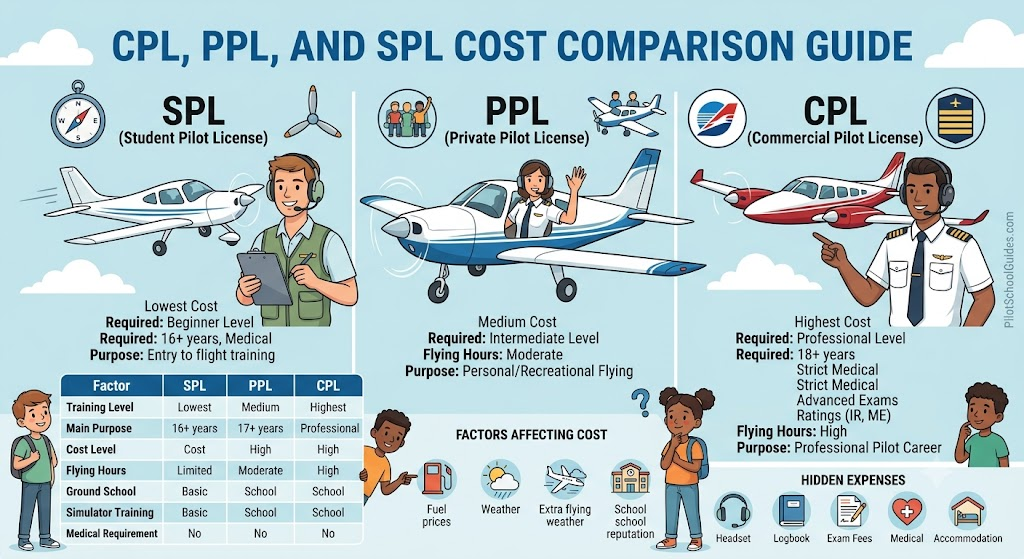
SPL, PPL, and CPL are different stages of pilot training. Each license has a different purpose, training requirement, flying hour structure, medical requirement, and cost level. Some students want to explore aviation as beginners, some want to fly privately, and some want to become professional commercial pilots.
This guide explains the cost comparison between Student Pilot License, Private Pilot License, and Commercial Pilot License in a simple way. It also covers hidden expenses, budgeting tips, and important cost factors students should check before starting pilot training.
Understanding SPL, PPL, and CPL
What Is SPL?
SPL stands for Student Pilot License. It is usually the first step for students who want to begin practical flight training. SPL allows a student to start flying under supervision as part of a recognized training program.
SPL is not a professional pilot license. It is mainly an entry-level authorization that helps beginners move from ground learning to basic flight training.
SPL is generally the least expensive stage because it involves basic documentation, medical checks, ground preparation, and initial training requirements.
What Is PPL?
PPL stands for Private Pilot License. It is suitable for people who want to fly aircraft for personal or recreational purposes. A PPL holder can fly privately but cannot usually work as a paid commercial pilot.
PPL training costs more than SPL because it includes more flying hours, practical flight lessons, instructor training, ground classes, examinations, and aircraft usage.
PPL is a good option for aviation enthusiasts, private aircraft owners, and students who want to build flying experience before deciding on a professional career.
What Is CPL?
CPL stands for Commercial Pilot License. It is required for students who want to become professional pilots and work in commercial aviation.
CPL is the most expensive among SPL, PPL, and CPL because it requires advanced flight training, more flying hours, simulator practice, medical fitness, examinations, navigation training, instrument training, and professional-level preparation.
For students planning an airline or commercial aviation career, CPL is the most important license stage.
SPL Cost Breakdown
SPL usually has the lowest cost among the three licenses. The expenses may vary depending on the country, flying school, documentation requirements, and medical examination process.
Common SPL expenses include:
- Registration fee
- Medical examination fee
- Basic ground classes
- Student pilot documentation
- Study materials
- Examination charges
- Basic administrative fee
SPL is affordable compared to PPL and CPL because it is an entry-level license. It does not require the same number of flying hours as advanced licenses.
PPL Cost Breakdown
PPL cost is higher than SPL because it involves actual flight training and more structured learning. Students need to complete required flying hours and pass theory and practical assessments.
Common PPL expenses include:
- Admission fee
- Ground school fee
- Aircraft flying charges
- Instructor fees
- Simulator training if included
- Examination fees
- Medical test charges
- Study materials
- Logbook and documentation
- License processing charges
PPL cost depends heavily on flying hours. If a student needs extra practice, the total cost may increase.
CPL Cost Breakdown
CPL is the highest investment because it prepares students for professional flying careers. It includes advanced ground training, higher flying hour requirements, navigation exercises, instrument training, simulator sessions, and licensing procedures.
Common CPL expenses include:
- Ground school fee
- Flying hour charges
- Aircraft rental cost
- Instructor fees
- Simulator sessions
- Instrument rating training
- Multi-engine training if required
- Medical examination
- Examination fees
- Documentation and licensing fee
- Study materials
- Accommodation and travel
- Extra flight hours if needed
CPL cost can vary significantly based on aircraft type, fuel price, airport location, training speed, weather delays, and school reputation.
CPL vs PPL vs SPL Cost Comparison Table
| Factor | SPL | PPL | CPL |
|---|---|---|---|
| Full Form | Student Pilot License | Private Pilot License | Commercial Pilot License |
| Training Level | Beginner | Intermediate | Professional |
| Main Purpose | Start pilot training | Private flying | Commercial flying career |
| Cost Level | Lowest | Medium | Highest |
| Flying Hours | Basic or limited | Moderate | High |
| Ground School | Basic | Detailed | Advanced |
| Simulator Training | Usually limited | Optional or basic | Important |
| Medical Requirement | Basic aviation medical | Required | Strict professional medical |
| Career Use | Training entry point | Personal flying | Paid pilot jobs |
| Best For | Beginners | Aviation enthusiasts | Future commercial pilots |
Why CPL Costs More Than PPL and SPL
CPL costs more because it requires a higher level of training and preparation. A commercial pilot must be ready to operate professionally and safely in more complex aviation environments.
CPL training usually includes more flight hours, advanced navigation, better aircraft handling, emergency procedures, instrument flying, simulator practice, and stronger theoretical knowledge.
The higher cost is not only for flying hours. It also includes professional preparation, instructor time, exams, medical requirements, and additional ratings.
Factors That Affect Pilot Training Cost
Pilot training costs are not the same everywhere. Several factors can increase or reduce the final amount.
1- Country and Aviation Rules
Different countries have different training rules, license requirements, and fee structures. This directly affects total cost.
2- Flying School Reputation
Well-known schools may charge higher fees because of better facilities, instructors, aircraft, and training systems.
3- Aircraft Type
Training on modern or advanced aircraft may cost more than training on basic aircraft.
4- Fuel Prices
Fuel is a major part of flying cost. If fuel prices rise, flying charges may also increase.
5- Instructor Fees
Experienced instructors may increase training quality, but instructor charges can affect the total cost.
6- Weather Delays
Bad weather can delay flying schedules. Long gaps may require revision flights, which can increase cost.
7- Extra Flying Hours
Some students need additional practice beyond minimum requirements. These extra hours add to the final expense.
8- Airport Location
Training at busy airports may involve additional operational costs. Less busy airports may offer faster flying schedules.
Hidden Costs Students Should Know
Many students calculate only flying school fees, but pilot training includes several additional expenses.
Hidden or extra costs may include:
- Uniform
- Pilot headset
- Books and study material
- Logbook
- Medical tests
- License renewal
- Exam reattempts
- Accommodation
- Food
- Local transportation
- Travel to training location
- Additional flying hours
- Simulator extra sessions
- Documentation charges
- Insurance if applicable
Students should always ask for a complete written cost estimate before admission.
How Students Can Save Money on Pilot Training
Pilot training is expensive, but smart planning can reduce unnecessary expenses.
Useful tips include:
- Compare multiple flying schools
- Ask for a complete fee breakdown
- Avoid choosing only by lowest fee
- Study theory seriously before flying
- Maintain regular flying continuity
- Prepare well before each lesson
- Avoid long training gaps
- Track every payment
- Budget for extra flying hours
- Check loan or scholarship options
- Speak with current students and alumni
- Visit the school before admission
Good preparation can reduce repeated lessons, exam failures, and unnecessary delays.
Which License Offers the Best Value?
The best license depends on your goal.
SPL
SPL is best for students who are just starting aviation training. It is useful as an entry point but not enough for private or commercial flying.
PPL
PPL is best for people who want to fly privately. It offers more value for aviation enthusiasts who do not want a paid flying career.
CPL
CPL is best for students who want to become professional pilots. It requires the highest investment, but it is the most career-focused option.
No license is universally best. The right choice depends on your purpose, budget, and aviation career plan.
Common Mistakes Students Make While Planning Pilot Training Cost
Students often make these mistakes:
- Checking only the admission fee
- Ignoring hidden expenses
- Not budgeting for accommodation
- Choosing the cheapest school without checking quality
- Not asking about extra flying hour charges
- Ignoring medical fitness requirements
- Not planning for exam reattempts
- Believing unrealistic job promises
- Starting training without financial planning
- Not comparing multiple schools
Avoiding these mistakes can save money and reduce stress during training.
Pilot Training Budget Checklist
Before joining any flying school, prepare a budget for:
- Admission fee
- Ground school fee
- Flying hour charges
- Instructor fees
- Simulator training
- Medical examination
- Examination fees
- Study material
- Uniform
- Headset
- Logbook
- Accommodation
- Food
- Travel
- License processing
- Extra flying hours
- Emergency fund
A clear budget helps students stay financially prepared from start to finish.
FAQs
1- Which license costs the least?
SPL usually costs the least because it is the beginner-level license.
It involves basic documentation, medical checks, and initial training.
It does not require advanced flying hours like PPL or CPL.
Students use it as the first step in pilot training.
2- Why is CPL more expensive?
CPL is more expensive because it requires advanced training and more flying hours.
It prepares students for professional commercial flying.
Costs include aircraft usage, instructor fees, simulator sessions, exams, and ratings.
It is the most career-focused pilot license.
3- Is PPL cheaper than CPL?
Yes, PPL is generally cheaper than CPL.
PPL is mainly for private or recreational flying.
CPL requires more advanced training and professional-level preparation.
That is why CPL has a higher total cost.
4- Can I become a commercial pilot with PPL?
No, PPL alone is not enough for paid commercial flying.
A PPL allows private flying privileges.
To work as a professional pilot, students usually need CPL.
Additional ratings and approvals may also be required.
5- Are hidden costs common in pilot training?
Yes, hidden costs can occur if students do not check details early.
These may include accommodation, medical tests, exam reattempts, and extra flying hours.
Always ask for a written fee structure.
This helps avoid unexpected financial pressure.
6- Can flying hours increase total cost?
Yes, flying hours are one of the biggest cost factors.
If a student needs extra practice, the total cost can increase.
Weather delays and training gaps can also affect progress.
Regular practice helps reduce unnecessary extra hours.
7- Is simulator training included in the fee?
It depends on the flying school and course package.
Some schools include simulator training, while others charge separately.
Students should ask this before admission.
Simulator training can improve confidence and procedure practice.
8- How can students reduce pilot training expenses?
Students can reduce costs by preparing well, flying regularly, and avoiding long gaps.
Comparing schools and understanding fee structures also helps.
Strong theory preparation can reduce exam reattempts.
Good planning prevents unnecessary spending.
9- Is the cheapest flying school the best option?
Not always.
The cheapest school may not offer the best aircraft, instructors, or training quality.
Students should compare safety, approval, aircraft availability, and student reviews.
Value is more important than only low fees.
10- Should parents plan extra budget?
Yes, parents should plan extra budget beyond the basic course fee.
Pilot training may include travel, stay, food, medical, and additional flying costs.
An emergency fund is useful.
This avoids financial stress during training.
Conclusion
Understanding the cost difference between SPL, PPL, and CPL is very important before starting pilot training. SPL is the most basic and affordable stage, PPL is suitable for private flying, and CPL is the highest investment for students who want a professional aviation career.
Students should not compare only the course fee. They should also consider flying hours, instructor fees, simulator charges, medical tests, exams, accommodation, travel, and hidden expenses.
The right pilot license depends on your goal. If you are exploring aviation, SPL is the first step. If you want to fly privately, PPL may be suitable. If you want to become a professional pilot, CPL is the right path.
With proper planning, clear budgeting, and careful school comparison, students can begin their pilot training journey with confidence and avoid unexpected financial pressure.

