
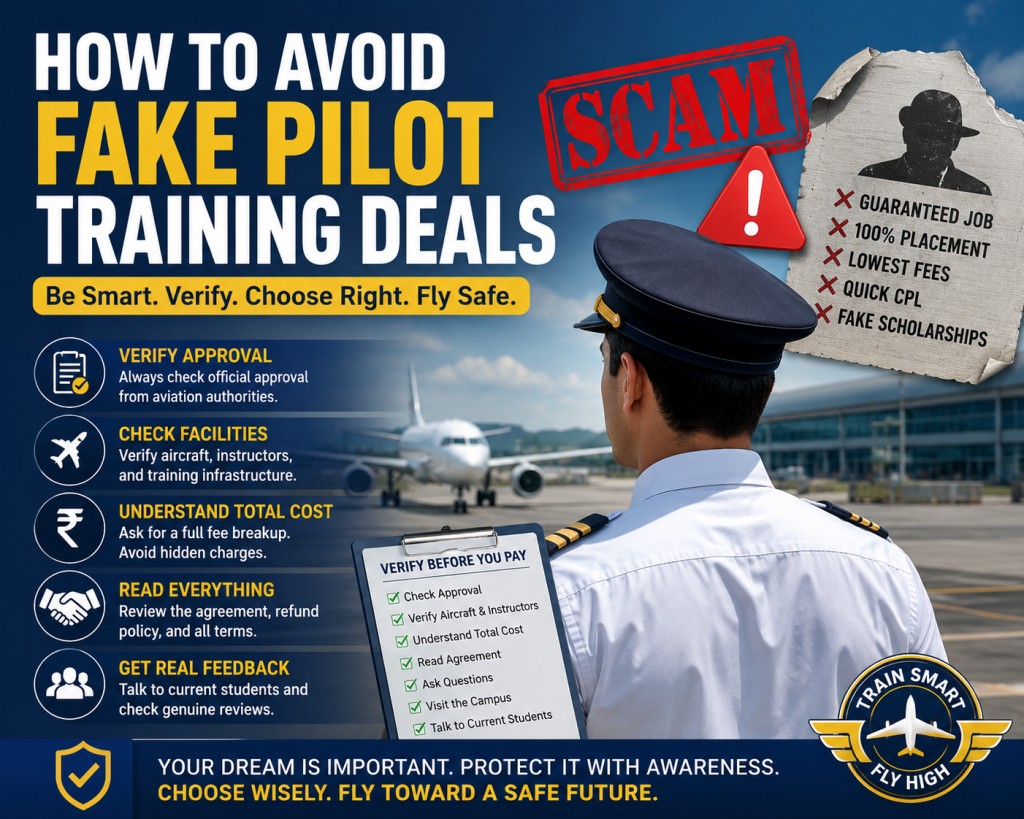
Introduction
Pilot training is a major investment. Students and parents often spend a large amount of money, time, and effort to build a future aviation career. Because pilot training is expensive and competitive, many fake offers, misleading advertisements, and unrealistic promises target aspiring pilots.
Some deals may look attractive at first: low fees, guaranteed airline jobs, quick CPL completion, foreign training packages, or fake scholarships. But if the offer is not genuine, students may lose money, waste time, and face serious career delays.
This blog explains how to avoid fake pilot training deals and choose a genuine, transparent, and reliable flight training option.
Why Fake Pilot Training Deals Exist
Pilot training scams exist because many students dream of becoming pilots but do not fully understand the process. Scammers take advantage of this lack of awareness.
Fake deals often appear because of:
- High demand for pilot careers
- Expensive training fees
- Social media promotions
- Lack of student awareness
- Pressure to join quickly
- Fake aviation consultants
- Misleading scholarship claims
- False airline placement promises
A genuine pilot career takes planning, verified training, medical fitness, exams, flying hours, and patience. Any shortcut promise should be checked carefully.
What Is a Fake Pilot Training Deal?
A fake pilot training deal is any offer that misleads students about training cost, approval status, job placement, flying hours, licence process, or career outcome.
It may include:
- Fake flight school admission
- False approval claims
- Unrealistic discounts
- Hidden charges
- Fake scholarship offers
- Guaranteed airline job promises
- Fake foreign training partnerships
- No proper agreement
- Pressure for urgent payment
A fake deal usually focuses more on collecting money than providing genuine training.
Common Types of Pilot Training Scams
Fake Flight Schools
Some organizations claim to be flight schools without proper approval, aircraft, instructors, or training facilities. They may show attractive brochures but cannot provide real flying training.
Before paying, verify whether the school is officially approved by the relevant aviation authority.
Fake Approval Claims
A training provider may claim to be approved by DGCA, FAA, EASA, or another authority without proof. Never trust only verbal claims or social media posts.
Always check official records and ask for approval documents.
Guaranteed Airline Job Offers
No genuine flight school can guarantee an airline job for every student. Airlines have their own hiring process, medical standards, simulator checks, interviews, and market conditions.
A school may offer placement support, but guaranteed airline employment should be treated as a warning sign.
Guaranteed CPL Completion
No school can honestly guarantee CPL completion within an exact short timeline for every student. Weather, aircraft availability, exams, student performance, medical validity, and documentation can all affect training duration.
Fake Scholarships
Some scammers advertise fake scholarships to attract students. They may ask for registration fees, processing fees, or document charges.
A genuine scholarship should have clear eligibility, written terms, official contact details, and transparent selection criteria.
Hidden Training Costs
A low advertised fee may not include important costs such as fuel surcharge, simulator fees, accommodation, books, exam fees, medical fees, or licence processing charges.
Always ask for a full cost breakup.
Fake International Training Packages
Some agents promote foreign pilot training packages without explaining licence conversion, visa rules, living expenses, regulatory differences, or hidden costs.
Students must verify the foreign school, training approval, total cost, and conversion process before enrolling.
Fake Aviation Consultants
Some consultants claim they can secure admission, licences, or airline interviews through special contacts. They may ask for large advance payments without written proof.
A genuine consultant provides transparent guidance, not false guarantees.
Warning Signs of Fake Pilot Training Offers
Be careful if you notice these red flags:
- Very low fees compared to market rates
- Guaranteed airline job promise
- Pressure to pay immediately
- No written agreement
- No official invoice
- Cash-only payment request
- No verified campus
- No aircraft details
- No instructor information
- Poor communication
- Fake-looking reviews
- No refund policy
- No clear fee structure
- No approval proof
- Unrealistic training timeline
If an offer looks too good to be true, it usually needs deeper verification.
How to Verify a Flight School
Before paying any money, verify the flight school properly.
Check:
- Official approval status
- Aircraft fleet
- Instructor qualifications
- Aircraft maintenance quality
- Safety record
- Student feedback
- Training history
- Ground school support
- Simulator availability
- Average completion timeline
- Fee transparency
- Licence support process
If possible, visit the campus in person. A physical visit can reveal much more than online advertisements.
Questions to Ask Before Paying
Ask these questions before enrolling:
- Is the school officially approved?
- Which aviation authority regulates it?
- How many aircraft are active?
- How many instructors are available?
- What is included in the fee?
- What is not included in the fee?
- Are fuel charges included?
- Are exam fees included?
- What is the refund policy?
- What is the average training duration?
- Can I meet current students?
- Can I see training aircraft?
- Can I review the agreement before payment?
- Will I get official receipts?
- Are there any extra charges later?
A genuine school should answer clearly.
Hidden Costs Students Often Miss
Pilot training has many cost components. Students should not look only at the headline fee.
Common hidden costs include:
- Flying hour charges
- Fuel surcharge
- Landing charges
- Simulator fees
- Medical examination fees
- Ground school fees
- Study material
- Uniform
- Headset
- Accommodation
- Food
- Local transport
- Exam fees
- Licence processing fees
- Visa fees for foreign training
- Insurance
- Recheck or repeat flight costs
Always request a complete written cost estimate.
Safe Payment Practices
Money safety is very important.
Follow these practices:
- Pay only to official school accounts
- Avoid cash payments
- Ask for invoices
- Keep receipts
- Read the agreement
- Avoid full payment without clarity
- Use traceable payment methods
- Verify bank account name
- Avoid paying personal accounts
- Keep email records
Never pay large amounts only because someone says the seat will be lost.
Importance of Reading the Agreement
A training agreement protects both the student and the school.
Read the agreement carefully before signing. Check:
- Total fee
- Payment schedule
- Refund policy
- Flying hour policy
- Training timeline
- Included services
- Excluded costs
- Student responsibilities
- School responsibilities
- Cancellation rules
- Documentation process
Do not sign if terms are unclear.
Role of Parents in Avoiding Fake Deals
Parents should be actively involved because pilot training is a major financial decision.
Parents can help by:
- Researching flight schools
- Visiting campuses
- Checking approval documents
- Reviewing agreements
- Asking cost-related questions
- Speaking with current students
- Avoiding emotional pressure
- Comparing multiple options
A second opinion can prevent costly mistakes.
Genuine Signs of a Good Flight School
A trustworthy flight school usually has:
- Verified approval
- Transparent fees
- Real aircraft fleet
- Qualified instructors
- Proper safety culture
- Clear communication
- Written agreements
- Official invoices
- Student support
- Realistic timelines
- Honest career guidance
- Proper training records
Good schools do not need fake promises to attract students.
Pilot Training Deal Comparison Checklist
| Factor | Genuine Deal | Risky Deal |
|---|---|---|
| Approval | Verified officially | Only verbal claim |
| Fee | Transparent breakup | Very low headline price |
| Job promise | Placement guidance | Guaranteed airline job |
| Payment | Official account and receipt | Cash or personal account |
| Agreement | Written and clear | No written terms |
| Campus | Visit possible | Location unclear |
| Aircraft | Fleet details shared | No aircraft proof |
| Timeline | Realistic estimate | Unrealistic quick completion |
| Reviews | Mixed but genuine | Only perfect fake reviews |
Social Media Pilot Training Ads
Many students discover flight schools through Instagram, Facebook, YouTube, or Google ads. Social media can be useful, but it should not be your only source of trust.
Do not rely only on:
- Attractive reels
- Edited aircraft photos
- Influencer promotions
- Paid testimonials
- Fake urgency
- “Limited seat” pressure
- Discount banners
Use social media for discovery, not final decision-making.
Foreign Pilot Training Deals
Foreign pilot training can be genuine, but it must be verified carefully.
Check:
- School approval in that country
- Visa requirements
- Accommodation cost
- Weather conditions
- Training duration
- Licence conversion process
- Extra exams
- Medical requirements
- Total living expenses
- Refund terms
- Safety record
A cheap foreign package may become expensive if conversion, living costs, and hidden fees are ignored.
Common Myths About Pilot Training Deals
| Myth | Fact |
|---|---|
| Cheapest school is always best | The cheapest option may hide extra costs |
| Guaranteed jobs are normal | Airline jobs cannot be guaranteed by every school |
| Big discounts always save money | Discounts may exclude major training costs |
| Social media popularity proves trust | Paid promotions do not prove quality |
| Foreign training is always better | It depends on school quality and licence conversion |
| Consultants can guarantee CPL | CPL depends on exams, flying hours, medicals, and performance |
| Full advance payment is always required | Payment terms should be clear and safe |
What to Do If You Suspect Fraud
If you suspect a fake pilot training deal:
- Stop payment immediately
- Save all messages and receipts
- Ask for written clarification
- Verify approval independently
- Speak with aviation authority where applicable
- Consult a legal advisor if money is involved
- Warn other students carefully with facts
- Report fraud through proper channels
Do not ignore doubts when large money is involved.
Tips to Choose the Right Flight School
Before choosing a flight school:
- Compare multiple schools
- Visit the campus
- Verify approval
- Meet instructors
- Talk to current students
- Ask for complete fee breakup
- Review the agreement
- Check aircraft availability
- Understand training duration
- Avoid rushed decisions
A genuine aviation career begins with a genuine training decision.
Frequently Asked Questions
1. How can I identify a fake pilot training offer?
A fake offer usually includes unrealistic discounts, guaranteed airline jobs, urgent payment pressure, no written agreement, no approval proof, and unclear fees. Always verify before paying.
2. Are guaranteed airline jobs genuine?
Be careful. No flight school can guarantee airline jobs for every student because airline hiring depends on vacancies, interviews, medical fitness, simulator checks, and performance.
3. How do I verify a flight school?
Check official approval, visit the campus, review aircraft details, meet instructors, talk to current students, and request written documents before payment.
4. Should I trust large discounts?
Large discounts should be checked carefully. Sometimes the advertised fee excludes important costs such as fuel, simulator, exams, medicals, accommodation, or licence processing.
5. What hidden fees should I expect?
Hidden fees may include fuel surcharge, landing charges, simulator cost, exam fees, medical fees, books, uniforms, accommodation, headset, and licence processing.
6. Is visiting the campus important?
Yes. A campus visit helps confirm whether the school has real aircraft, instructors, classrooms, facilities, and active students.
7. Should I pay the full amount in advance?
Avoid paying the full amount without a clear agreement, invoice, refund policy, and official payment channel. Use safe and traceable payment methods.
8. What documents should I request?
Ask for approval proof, fee structure, agreement copy, refund policy, payment receipt, training syllabus, aircraft details, and student support information.
9. How can parents verify a school?
Parents can verify approvals, visit the campus, review documents, speak with current students, compare schools, and check whether the offer is realistic.
10. What should I do if I suspect fraud?
Stop payment, save all proof, ask for written clarification, verify independently, and report the matter to appropriate authorities or seek legal advice if needed.
Conclusion
Avoiding fake pilot training deals requires patience, research, and careful verification. Students should never choose a flight school only because of low fees, social media ads, or guaranteed job promises. A genuine training provider will be transparent about approvals, costs, aircraft, instructors, timelines, and refund policies.
Pilot training is a serious career investment. Take time to compare schools, ask questions, read agreements, verify approvals, and involve parents or trusted advisors. A safe and informed decision today can protect your money, time, and aviation future.

