
Introduction
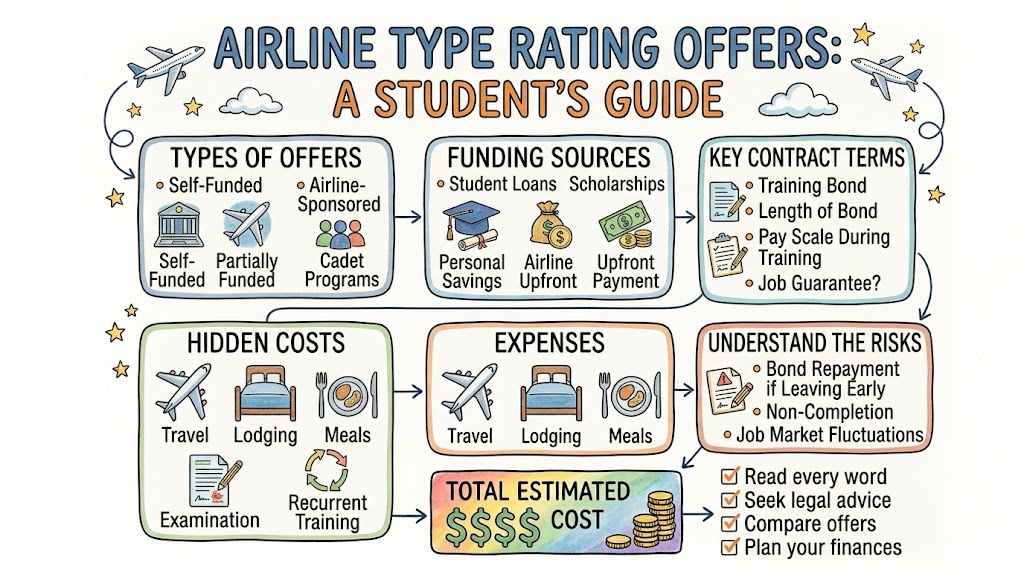
After completing a Commercial Pilot Licence, many students begin searching for airline type rating opportunities. They may find advertisements for sponsored training, discounted courses, conditional job offers, airline-linked programs and complete type rating packages.
These offers can look similar, but they may involve very different financial and employment conditions.
One offer may provide training only. Another may include an airline assessment but no guaranteed job. A third may connect training with conditional employment, salary deductions or a long-term training bond.
Students must understand exactly what is being offered before paying a registration fee, signing a contract or taking a large loan.
This Pilotsdeal.com guide explains the main types of airline type rating offers, their benefits, possible risks and the questions every commercial pilot should ask before accepting one.
What Is an Airline Type Rating Offer?
An airline type rating offer is a training or employment arrangement connected with qualification on a specific commercial aircraft.
Common aircraft types include:
- Airbus A320 family
- Boeing 737 family
- ATR 42/72
- Bombardier Q400
- Embraer E-Jet family
- Airbus A330
- Boeing 777
- Boeing 787
- Airbus A350
A type rating normally includes aircraft-specific theoretical instruction, cockpit procedures, simulator training and a skill test.
However, an airline-related offer may also include:
- Airline screening
- Multi-Crew Cooperation training
- Upset Prevention and Recovery Training
- Base training
- Standard operating procedure training
- Operator conversion training
- Line training
- Conditional employment
- Salary-based repayment
- Training bond
- Accommodation or transportation
The exact content depends on the airline, training organisation and contract.
Why Students Must Study the Offer Carefully
The phrase airline type rating offer does not automatically mean that the airline is paying for the training or providing guaranteed employment.
It may refer to:
- A course promoted as useful for airline applications
- A training provider working with an airline
- An airline assessment followed by self-funded training
- A conditional job offer that depends on successful training
- A training bond recovered through salary
- A private type rating with no employment agreement
- A program that offers an interview but not a job
- A course that includes base training but not line training
Students should therefore separate three different questions:
- Who is providing the training?
- Who is paying for it?
- Is employment genuinely included?
Clear answers to these questions can prevent expensive misunderstandings.
Main Types of Airline Type Rating Offers
Fully Airline-Sponsored Type Rating
Under a fully sponsored arrangement, the airline pays most or all of the type rating cost.
The student may still need to pay for:
- Medical examinations
- Licence verification
- Travel
- Accommodation
- Personal documents
- Uniform
- Local transportation
A fully sponsored program may require the pilot to sign a service agreement or remain with the airline for a minimum period.
Possible Advantages
- Low upfront training cost
- Training aligned with airline procedures
- Clearer pathway toward line operations
- Reduced risk of selecting the wrong aircraft type
- Training completed according to operator requirements
Possible Conditions
- Minimum employment period
- Repayment if the pilot resigns early
- Salary deductions
- Performance requirements
- Medical and background checks
- Relocation requirements
- Recovery of costs after dismissal for misconduct
Students should read the repayment clause carefully, even when the airline initially pays the course fee.
Partially Sponsored Type Rating
In a partially sponsored offer, the airline and pilot share the training cost.
The airline may pay for:
- Part of the simulator program
- Skill test
- Base training
- Operator conversion
- Line training
The pilot may pay for:
- Initial type rating
- Ground school
- MCC or APS MCC
- UPRT
- Travel and accommodation
- Administrative charges
This arrangement can reduce the pilot’s financial burden, but the complete personal contribution must be confirmed before signing.
Ask whether the airline contribution is:
- Paid directly to the training provider
- Reimbursed after course completion
- Recovered through salary
- Conditional on passing every assessment
- Cancelled if the joining date is delayed
Self-Sponsored Type Rating With Airline Selection
Some airlines select pilots first but require them to fund the type rating personally.
The normal sequence may be:
- Application
- Written or technical test
- Psychometric assessment
- Simulator assessment
- Interview
- Conditional selection
- Self-funded type rating
- Final checks
- Airline induction
This can be more secure than completing a type rating without any airline connection, but it still carries risk.
The employment offer may depend on:
- Successful course completion
- Passing the skill test
- Meeting airline standards
- Continued medical fitness
- Background verification
- Availability of vacancies
- Immigration or work-permit approval
- Completion within a specified time
Students should confirm whether employment is guaranteed after successful training or remains subject to additional selection.
Pay-to-Fly or Self-Funded Line Training Offer
Some arrangements require pilots to pay not only for the type rating but also for operational experience or line training.
Such offers may include:
- Type rating
- Base training
- Operator conversion
- A fixed number of flight sectors
- A limited number of airline hours
- Temporary placement with an operator
These programs require especially careful investigation.
Students must confirm:
- The identity of the operating airline
- Whether the flying is conducted under a valid employment arrangement
- Whether the pilot receives a salary
- Whether the hours are legally loggable
- Whether the training is accepted by future employers
- What happens if operations stop
- Whether additional payment is required later
- Whether the pilot receives employment after the promised hours
A package selling flight experience is not automatically the same as a regular airline job.
Type Rating With Conditional Employment
A conditional employment offer usually means the candidate has been selected but must satisfy specific conditions before officially joining.
Conditions may include:
- Completing an approved type rating
- Passing the skill test
- Completing base training
- Maintaining a valid Class 1 medical
- Obtaining licence endorsement
- Passing security checks
- Receiving a work visa
- Completing document verification
- Meeting language requirements
The offer letter should identify every condition clearly.
Students should also check:
- The joining deadline
- Whether the airline can withdraw the offer
- Whether training fees are refundable
- Whether employment begins immediately after training
- What happens when fleet requirements change
- Whether salary starts during training
Conditional employment is more meaningful than a general placement promise, but it is not identical to an unconditional employment contract.
Type Rating With a Training Bond
A training bond is an agreement requiring the pilot to remain with the airline for a stated period or repay part of the training expense.
For example, a bond may reduce gradually as the pilot completes service.
A bond contract should explain:
- Total bond value
- Bond duration
- Repayment calculation
- Monthly reduction
- Interest or penalty
- Resignation conditions
- Termination conditions
- Medical-loss provisions
- Redundancy provisions
- Training-failure consequences
- Applicable law and dispute process
Questions Students Should Ask
- Is the bond value equal to the real training cost?
- Does the amount reduce every month?
- Must the pilot repay when the airline ends employment?
- What happens after permanent medical disqualification?
- Does the bond include line training?
- Is a guarantor required?
- Can the airline recover the amount from salary?
- Is the agreement enforceable in the pilot’s country?
Independent legal review may be appropriate before signing a large or complicated bond.
Salary-Deduction Type Rating Offer
Some airlines initially arrange the training and recover the cost through monthly salary deductions.
This can reduce the need for a large personal loan.
However, students should calculate their actual take-home salary after:
- Type rating deduction
- Tax
- Accommodation
- Transportation
- Insurance
- Uniform charges
- Licence expenses
- Food and personal costs
Ask whether:
- Interest is added
- Deductions start during training
- Repayment continues after resignation
- Early repayment is allowed
- The remaining balance becomes immediately payable after termination
- Currency changes can affect the balance
A salary-deduction offer may be affordable only when the post-deduction salary can support normal living expenses.
Type Rating Offer Through an Airline Cadet Program
Cadet programs may combine several stages, including:
- Ground training
- CPL training
- Instrument rating
- Multi-engine qualification
- MCC or APS MCC
- Type rating
- Airline-specific training
- Conditional employment
Some programs include the type rating in the full fee, while others charge it separately near the end of training.
Students should confirm:
- Whether the type rating fee is fixed
- Whether price increases are possible
- Which aircraft type will be assigned
- Whether aircraft assignment can change
- Whether additional selection occurs before type rating
- What happens if the airline delays hiring
- Whether training continues when fleet plans change
- Whether a refund is available after unsuccessful progression
A cadet pathway can provide a structured route, but students should understand that every stage may have separate performance requirements.
Training Provider Offer Without Airline Employment
Many type rating courses are offered directly by approved training organisations rather than airlines.
Such offers can provide valid training, but they should not be described or understood as employment offers unless a genuine airline agreement exists.
The provider may offer:
- Ground school
- Simulator training
- Skill test
- Base training assistance
- Interview preparation
- Recruitment guidance
- Access to vacancy information
These services may be useful, but the student should not assume they include:
- Airline selection
- Employment
- Line training
- Salary
- Work visa
- Guaranteed interview
DGCA maintains information concerning approved training organisations and airline type rating programs. Students training for an Indian licence should verify the organisation and relevant approval through official DGCA records rather than depending solely on promotional claims.
Understand What the Offer Actually Includes
Every student should request a detailed inclusion and exclusion list.
Training Components to Check
- Aircraft systems training
- Computer-based learning
- Instructor-led ground school
- Cockpit procedure trainer
- Fixed-base simulator
- Full-flight simulator
- Crew resource management
- MCC or APS MCC
- UPRT
- Progress checks
- Skill-test preparation
- Skill test
- Examiner
- Base training
- Licence endorsement support
Career Components to Check
- Airline assessment
- Interview
- Conditional employment letter
- Employment contract
- Operator conversion course
- Line training
- Minimum guaranteed hours
- Salary during training
- Joining date
- Fleet and base assignment
Financial Components to Check
- Course fee
- Registration fee
- Taxes
- Simulator fees
- Retest charges
- Base-training cost
- Travel
- Visa
- Accommodation
- Uniform
- Licence fees
- Security deposit
- Training bond
- Salary deductions
Type Rating Offer Comparison Table
| Offer Type | Who Usually Pays? | Employment Connection | Main Risk |
|---|---|---|---|
| Fully sponsored | Airline | Usually strong | Training bond or service obligation |
| Partially sponsored | Airline and pilot | Usually present | Unexpected pilot contribution |
| Self-funded after selection | Pilot | Conditional | Job depends on successful completion |
| Salary deduction | Airline initially | Usually present | Reduced take-home salary |
| Cadet program | Pilot, airline or both | Structured but conditional | High total program cost |
| Training provider package | Pilot | Usually none | Qualification without job opportunity |
| Pay-to-fly arrangement | Pilot | Limited or temporary | Paying for experience without stable employment |
| Type rating plus interview | Pilot | Interview only | No guarantee of selection |
Verify Regulatory Approval
The type rating must be suitable for endorsement on the pilot’s licence.
Students should verify:
- Training organisation approval
- Exact aircraft type
- Training location
- Simulator qualification
- Examiner authorisation
- Skill-test acceptance
- Licence endorsement process
- Differences-training requirements
EASA publishes separate type rating and licence endorsement lists for aeroplanes, helicopters and airships. These lists identify how aircraft are categorised for licensing under the applicable European flight-crew rules.
The FAA also publishes current type-rating designations and practical testing standards. Students following an FAA pathway must confirm the exact designation and certification requirements applying to the aircraft.
A company logo or statement saying “internationally recognised” is not enough. Approval must be confirmed through the appropriate authority.
Distinguish Type Rating, Base Training and Line Training
Students often treat these terms as one complete process, but they are different stages.
Type Rating
Aircraft-specific ground and simulator training followed by the required skill test.
Base Training
Take-offs and landings completed in the actual aircraft when required.
Operator Conversion Training
Training that introduces the airline’s procedures, manuals, policies and operational standards.
Line Training
Supervised training during actual airline operations.
An offer containing only a type rating should not be described as a complete airline-entry package.
Ask whether each stage is:
- Included
- Guaranteed
- Charged separately
- Completed by the same organisation
- Subject to another assessment
- Dependent on airline vacancies
Check Whether Base Training Is Guaranteed
A training provider may include base training in the quotation without confirming the aircraft or date.
Students should ask:
- Which airline or operator provides the aircraft?
- Where will base training take place?
- How many landings are included?
- Is the aircraft date confirmed?
- What is the average waiting period?
- Who pays for accommodation during delays?
- What happens if the aircraft becomes unavailable?
- Is the base-training fee refundable?
- Will the documentation be accepted by the licensing authority?
A written base-training commitment is stronger than a verbal promise.
Understand Airline Assessments
An offer may require the student to pass several assessments.
These can include:
- Technical examination
- Aptitude testing
- Psychometric assessment
- English-language evaluation
- Group exercise
- Human-resources interview
- Simulator assessment
- Medical examination
- Background verification
Ask whether the assessment is conducted:
- Before payment
- Before type rating
- During the course
- After training completion
- Before employment
- Before line training
The safest arrangement generally identifies employment eligibility before the pilot makes the largest payment.
Check the Employment Letter
A genuine airline-linked offer should identify the relationship between training and employment.
Review whether the document is:
- A course admission letter
- An interview invitation
- A letter of intent
- A conditional offer
- A provisional employment offer
- A final employment contract
These documents do not provide the same level of commitment.
Check for:
- Airline’s legal name
- Candidate’s role
- Aircraft type
- Base location
- Salary
- Training period
- Probation
- Joining date
- Conditions
- Bond
- Notice period
- Termination rules
- Refund or repayment obligations
Do not assume that a letter using the airline’s name is an employment contract.
Hidden Costs Students Should Expect
The advertised offer may exclude:
- Application fee
- Selection fee
- Medical examination
- Licence verification
- Travel
- Visa
- Accommodation
- Food
- Local transportation
- MCC
- APS MCC
- UPRT
- Simulator assessment
- Skill test
- Examiner charge
- Base training
- Additional simulator sessions
- Retest
- Licence endorsement
- Uniform
- Security deposit
- Airline induction
- Tax and bank charges
Students should create an all-inclusive budget before accepting the offer.
Sample Total Cost Worksheet
| Expense Area | Quoted Amount | Confirmed Included? | Possible Extra Cost |
|---|---|---|---|
| Registration | |||
| Type rating course | |||
| Simulator training | |||
| Skill test | |||
| Examiner | |||
| MCC or APS MCC | |||
| UPRT | |||
| Base training | |||
| Travel and visa | |||
| Accommodation | |||
| Licence endorsement | |||
| Retest reserve | |||
| Total |
Completing this table for every offer makes comparison easier.
Questions to Ask the Airline
Before signing, ask:
- Is this an employment offer or only a training offer?
- Is the job guaranteed after successful training?
- What conditions must be completed before joining?
- Who pays for the type rating?
- Is any part recovered through salary?
- Is there a training bond?
- What happens if the airline delays the joining date?
- Is base training included?
- Is line training included?
- Is salary paid during training?
- What happens if the aircraft fleet changes?
- What happens after medical disqualification?
- Can the airline terminate the agreement before joining?
- Is the payment refundable?
- When does the employment contract begin?
Questions to Ask the Training Provider
Ask the training organisation:
- Which authority approves the course?
- What is the approval number?
- Is the exact training location approved?
- Which aircraft variant is covered?
- How many simulator hours are included?
- Which simulator will be used?
- Is the skill test included?
- Is the examiner fee included?
- Is base training guaranteed?
- What does one additional session cost?
- What happens if the student fails?
- What happens if the provider postpones training?
- Is the deposit refundable?
- Does the provider have a written agreement with the airline?
- Can that agreement be independently verified?
Warning Signs in Type Rating Offers
Students should be cautious when an offer includes:
- Guaranteed employment without assessment
- Pressure to pay immediately
- Payment into a personal account
- No written contract
- No verifiable approval number
- No named airline
- No simulator location
- No confirmed base training
- Unclear refund rules
- Hidden examiner charges
- Unrealistically short training
- Guaranteed line-training hours without an operator
- Large placement fees
- Employment promises made only by an agent
- Refusal to provide a complete cost breakdown
Several warning signs together may indicate a high-risk arrangement.
Agent Versus Direct Airline Offer
Some programs are marketed through agents or aviation consultants.
An agent may help with:
- Applications
- Documentation
- Course coordination
- Visa assistance
- Travel
- Communication with the provider
However, students should verify everything directly with:
- The airline
- The training organisation
- The aviation authority
- The simulator centre
Ask whether the agent is officially authorised and whether payments should be made directly to the airline or training organisation.
Never rely only on social-media messages or messaging-app conversations for a major aviation investment.
Should Students Complete a Type Rating Before Airline Selection?
There is no single answer for every pilot.
A self-sponsored type rating may be useful when:
- Airlines are actively recruiting rated pilots
- The aircraft type is widely operated
- The student has sufficient financial reserves
- The course has valid approval
- The pilot understands recency requirements
- The qualification matches the target market
Waiting for airline selection may be safer when:
- Airlines provide their own training
- Recruitment demand is uncertain
- The pilot needs a large loan
- The course has no base-training arrangement
- The student has no clear target airline
- The rating may become inactive before employment
Students should make this decision using realistic hiring requirements rather than pressure from a course seller.
How to Compare Two Airline Type Rating Offers
Use a weighted comparison system.
| Selection Factor | Suggested Weight |
|---|---|
| Genuine employment connection | 25% |
| Regulatory approval | 20% |
| Complete cost transparency | 15% |
| Base and line-training pathway | 10% |
| Contract and refund protection | 10% |
| Airline stability and fleet relevance | 8% |
| Simulator and instructor quality | 7% |
| Training schedule | 5% |
| Total | 100% |
Rate each offer from one to five under every category.
An offer should not be selected when approval or employment claims cannot be verified, regardless of its overall score.
Frequently Asked Questions
What is an airline-sponsored type rating?
It is an arrangement in which an airline pays all or part of the aircraft-specific training cost. The pilot may need to sign a service bond or accept salary deductions.
Does an airline type rating offer guarantee a job?
Not always. Some offers provide training, an interview or conditional selection rather than guaranteed employment.
What is a conditional airline offer?
It means employment depends on the candidate completing specified requirements, such as type rating, medical checks, licence endorsement and background verification.
What is a type rating bond?
It is a contract requiring the pilot to serve the airline for a minimum period or repay part of the training cost.
Is base training included in every airline offer?
No. Base training may be included, arranged later or charged separately.
Is line training the same as a type rating?
No. A type rating is aircraft-specific qualification training. Line training involves supervised airline operations after the required qualification and operator training.
Should students pay for line training?
Any arrangement requiring payment for operational flying should be examined very carefully. Verify the operator, employment status, legality, insurance and future recognition of the experience.
How can students verify an airline-linked program?
Contact the airline and training organisation directly through official communication channels. Also verify the applicable regulatory approvals.
Is a salary-deduction offer better than taking a loan?
It may reduce the need for outside borrowing, but students must calculate the interest, deductions, take-home salary and repayment conditions.
What happens when a student fails the type rating?
The candidate may require remedial simulator training or another skill test. The employment offer may also be affected, depending on the contract.
Key Takeaways
- An airline type rating offer may be a training arrangement, employment pathway or financing structure.
- Sponsored does not always mean completely free.
- Conditional employment is different from guaranteed employment.
- Type rating, base training and line training are separate stages.
- Regulatory approval must be verified independently.
- Students should confirm the exact aircraft type and variant.
- Airline assessment may occur before or after payment.
- Training bonds and salary deductions require careful review.
- Every cost and exclusion should appear in writing.
- Large payments should not be made based only on verbal promises.
- Agents should be verified directly with the airline.
- A type rating does not automatically guarantee an airline career.
- Students should compare total financial risk, not only the advertised fee.
Conclusion
Airline type rating offers can create valuable career opportunities, but students must understand the complete arrangement before accepting one. Verify the airline connection, regulatory approval, employment conditions, total payment, training bond, base training and refund policy. A transparent offer should clearly explain who provides the training, who pays for it and what happens after successful completion.

