
Introduction
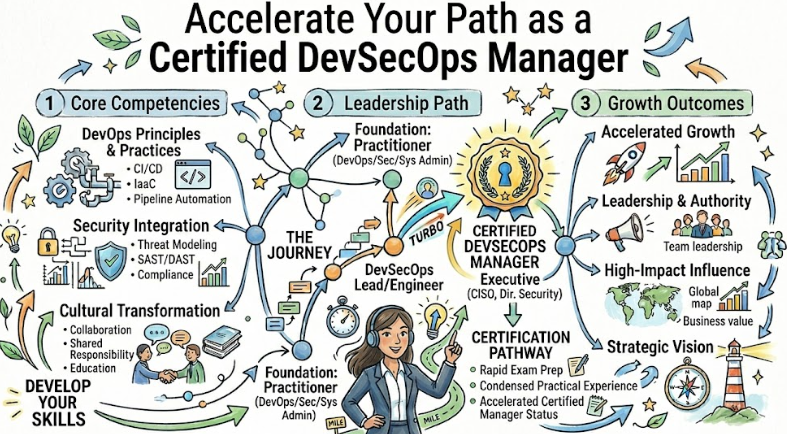
The Certified DevSecOps Manager is a comprehensive professional program designed to bridge the gap between technical security execution and high-level engineering management. This guide is crafted for professionals who need to navigate the complexities of modern software delivery where security is no longer an afterthought but a fundamental requirement. By positioning this certification within the broader landscape of DevOps, cloud-native engineering, and platform operations, we provide a roadmap for those looking to lead cross-functional teams.
This guide helps professionals make informed career decisions by clarifying the specific competencies required to govern secure pipelines in large-scale enterprise environments. Understanding these requirements is essential for anyone looking to advance within the ecosystem supported by DevSecOpsschool.
What is the Certified DevSecOps Manager?
The Certified DevSecOps Manager represents a shift from purely technical security implementation to a strategic leadership role focused on governance, culture, and automation. It exists because organizations today struggle not with a lack of security tools, but with a lack of managers who can integrate those tools into a fast-moving DevOps culture. This certification focuses on real-world, production-level challenges rather than abstract theory, ensuring that graduates can handle actual compliance and risk scenarios. It aligns with modern engineering workflows by emphasizing “Security as Code” and “Compliance as Code,” making security a seamless part of the developer experience.
Who Should Pursue Certified DevSecOps Manager?
This program is ideal for senior software engineers, Site Reliability Engineers (SREs), and cloud architects who are transitioning into leadership or management roles. It is also highly relevant for existing security professionals and data engineers who need to understand how security integrates into modern CI/CD pipelines. Engineering managers and technical leaders who oversee large teams will find the governance frameworks particularly useful for maintaining velocity while ensuring safety. Both the Indian tech market and the global engineering landscape are currently seeing a massive demand for leaders who can speak the language of both developers and security auditors.
Why Certified DevSecOps Manager is Valuable and Beyond
The value of this certification lies in the growing enterprise adoption of “Shift Left” and “Shield Right” strategies across the global software industry. As cyber threats become more sophisticated, the demand for managers who can oversee a secure software supply chain is increasing exponentially. This program helps professionals stay relevant by focusing on principles of governance and risk management that outlast specific tool versions or cloud providers. Investing time in this certification offers a high career return, as it positions you for roles like Head of DevSecOps, Platform Lead, or Director of Engineering.
Certified DevSecOps Manager Certification Overview
The program is officially delivered via Certified DevSecOps Manager and is hosted on the DevSecOpsschool platform. It is structured into multiple levels of proficiency, ensuring a logical progression from foundational concepts to advanced organizational strategy. The assessment approach is practical, often involving project-based evaluations that mirror production environments and enterprise security audits. This structure ensures that ownership of the certification reflects a true mastery of the management skills required to lead modern engineering departments.
Certified DevSecOps Manager Certification Tracks & Levels
The certification is divided into three primary levels: Foundation, Professional, and Advanced, each targeting a specific stage of career growth. The Foundation level focuses on core principles and culture, while the Professional level dives into tool orchestration and pipeline integration. The Advanced level is reserved for those steering enterprise-wide security transformations and high-level governance. These tracks allow professionals to specialize in areas like SRE security, FinOps compliance, or DevSecOps leadership depending on their career goals.
Complete Certified DevSecOps Manager Certification Table
| Track | Level | Who it’s for | Prerequisites | Skills Covered | Recommended Order |
| Management | Foundation | Aspiring Managers | Basic DevOps Knowledge | DevSecOps Culture, Risk Basics | 1 |
| Engineering | Professional | SRE / Lead Engineers | 3+ Years Experience | Tool Integration, Automation | 2 |
| Leadership | Advanced | Directors / VPs | 7+ Years Experience | Governance, Strategic Policy | 3 |
| Operations | Professional | Cloud Architects | Cloud Fundamentals | Infrastructure Security, IAC | 2 |
| Compliance | Professional | Security Auditors | Security Fundamentals | Compliance as Code, Auditing | 2 |
Detailed Guide for Each Certified DevSecOps Manager Certification
Certified DevSecOps Manager – Foundation
What it is
This level validates the candidate’s understanding of the fundamental shift from traditional security to integrated DevSecOps management. It confirms that the professional understands the cultural requirements for successful security integration.
Who should take it
Junior managers, team leads, or senior developers who are new to the management of security within a DevOps environment and want to build a strong theoretical and cultural base.
Skills you’ll gain
- Understanding the DevSecOps Manifesto and its core values.
- Identification of security bottlenecks in a standard CI/CD pipeline.
- Ability to facilitate communication between developers and security teams.
- Knowledge of basic risk assessment methodologies.
Real-world projects you should be able to do
- Conduct a cultural audit of an existing engineering team.
- Design a basic “Shift Left” roadmap for a startup or small team.
- Create a security awareness training plan for developers.
Preparation plan
- 7-14 days: Focus on the history of DevOps and the evolution of security culture.
- 30 days: Study common security tools like SAST and DAST at a high level.
- 60 days: Engage in mock interviews and cultural change management simulations.
Common mistakes
- Focusing too much on technical tool configuration instead of cultural leadership.
- Underestimating the importance of communication strategies.
Best next certification after this
- Same-track option: Professional Level Manager.
- Cross-track option: Certified SRE Practitioner.
- Leadership option: Project Management Professional.
Certified DevSecOps Manager – Professional
What it is
This certification validates the ability to orchestrate technical security controls and manage the automated lifecycle of vulnerabilities. It is the core technical management tier of the program.
Who should take it
DevOps leads, security engineers, and mid-level managers who are responsible for the day-to-day operation of secure pipelines and toolchains.
Skills you’ll gain
- Orchestrating SAST, DAST, and SCA tools within Jenkins or GitLab.
- Implementing automated security gates and build-breaking policies.
- Managing vulnerability backlogs and prioritization frameworks.
- Monitoring and logging for security incidents in production.
Real-world projects you should be able to do
- Build a fully automated pipeline with three integrated security stages.
- Implement a vulnerability dashboard for multiple microservices.
- Setup automated secret scanning and remediation workflows.
Preparation plan
- 7-14 days: Refresh knowledge on CI/CD orchestration and container security.
- 30 days: Deep dive into the integration APIs of major security scanners.
- 60 days: Build a lab environment and execute an end-to-end secure delivery workflow.
Common mistakes
- Failing to account for developer friction when setting up security gates.
- Neglecting the reporting and feedback loop required for management.
Best next certification after this
- Same-track option: Advanced Level Manager.
- Cross-track option: Certified Cloud Security Professional.
- Leadership option: Certified Information Security Manager.
Certified DevSecOps Manager – Advanced
What it is
This is a high-level credential that validates the ability to lead enterprise-wide security transformations and design long-term governance frameworks. It focuses on strategy and executive-level reporting.
Who should take it
Directors of Engineering, CISOs, VPs of Infrastructure, and seasoned technical leaders who need to manage security risk at the board level.
Skills you’ll gain
- Developing enterprise-wide security governance policies.
- Financial management and budgeting for DevSecOps initiatives.
- Leading large-scale organizational changes across multiple departments.
- Strategic selection of toolsets and vendor management.
Real-world projects you should be able to do
- Write a three-year strategic roadmap for an organization’s security posture.
- Design a global compliance framework that meets GDPR and SOC2 standards.
- Conduct a cost-benefit analysis of competing security technologies for the executive team.
Preparation plan
- 7-14 days: Review corporate governance and high-level risk management models.
- 30 days: Study global regulatory requirements and legal implications of security.
- 60 days: Present a strategic plan to a panel or peer group for feedback.
Common mistakes
- Staying too deep in the technical weeds and losing sight of business goals.
- Over-complicating policies to the point of organizational paralysis.
Best next certification after this
- Same-track option: Executive Leadership Programs.
- Cross-track option: Advanced FinOps Management.
- Leadership option: Executive MBA or Board Governance training.
Choose Your Learning Path
DevOps Path
Professionals on this path focus on making automation inherently secure. The learning journey involves taking existing CI/CD knowledge and layering on automated security testing and container hardening. This path leads to roles such as Lead DevOps Engineer or Platform Manager. It is designed for those who want to ensure that the infrastructure they build is as resilient as it is fast.
DevSecOps Path
This is the most direct path for those who want to become specialists in secure delivery. It covers everything from developer culture to automated compliance and production monitoring. Professionals here will eventually manage specialized DevSecOps teams. This path is ideal for those who see security as a core component of the software development lifecycle rather than a separate silo.
SRE Path
Site Reliability Engineers use this path to ensure that security incidents do not compromise system availability. The focus here is on resilience, chaos engineering for security, and incident response management. This path is perfect for those who manage high-traffic production environments where security and uptime are inextricably linked. It emphasizes the “Operations” part of the management certification.
AIOps Path
This path explores how artificial intelligence and machine learning can be used to manage security operations at scale. Professionals learn to oversee systems that automatically detect and remediate threats using intelligent algorithms. This is a forward-looking path for managers who want to lead teams using automated intelligence. It bridges the gap between high-volume data and actionable security insights.
MLOps Path
Focusing on the unique security challenges of machine learning models, this path covers data integrity, model poisoning prevention, and secure model deployment. It is essential for managers overseeing data science and ML engineering teams. The path ensures that the entire lifecycle of a machine learning model is protected from adversarial attacks. It addresses the specific vulnerabilities inherent in data-driven systems.
DataOps Path
Managers on this path focus on the security of data pipelines and compliance with privacy regulations. It covers data encryption, access control management, and the auditing of data movement across an organization. This path is vital for companies dealing with large volumes of sensitive customer information. It ensures that data remains secure as it flows from ingestion to analysis.
FinOps Path
This path combines the management of cloud costs with the management of security resources. It teaches leaders how to balance the budget for security tools against the potential financial risk of a data breach. This is ideal for managers who need to justify their security spend to the CFO or finance department. It highlights the economic impact of security decisions in a cloud-native world.
Role → Recommended Certified DevSecOps Manager Certifications
| Role | Recommended Certifications |
| DevOps Engineer | Certified DevSecOps Manager – Professional |
| SRE | Certified DevSecOps Manager – Professional |
| Platform Engineer | Certified DevSecOps Manager – Advanced |
| Cloud Engineer | Certified DevSecOps Manager – Foundation |
| Security Engineer | Certified DevSecOps Manager – Advanced |
| Data Engineer | Certified DevSecOps Manager – Foundation |
| FinOps Practitioner | Certified DevSecOps Manager – Professional |
| Engineering Manager | Certified DevSecOps Manager – Advanced |
Next Certifications to Take After Certified DevSecOps Manager
Same Track Progression
Once you have mastered the management levels, you should look toward deep specialization in specific domains like Cloud-Native Security or Application Security. Moving deeper within the track often involves taking on mentorship roles and contributing to the global body of knowledge in the field. This ensures that you remain at the cutting edge of the industry’s evolution.
Cross-Track Expansion
Expanding into related fields like SRE or FinOps will make you a more holistic leader. A manager who understands both the security and the financial health of an engineering organization is far more valuable than a specialist in one area. This broadening of skills allows you to participate in higher-level business strategy discussions.
Leadership & Management Track
For those aiming for the C-suite, the next step is moving toward general business leadership. This might include project management, organizational psychology, or corporate finance. These skills complement your technical management background, allowing you to bridge the gap between engineering and the board of directors.
Training & Certification Support Providers for Certified DevSecOps Manager
DevOpsSchool
DevOpsSchool is a globally recognized training organization that has pioneered the field of DevOps and DevSecOps education for over a decade. They provide a comprehensive suite of learning resources specifically tailored for the Certified DevSecOps Manager program. Their approach combines deep technical expertise with practical management frameworks, ensuring that candidates are prepared for both the certification exam and real-world leadership challenges. The platform offers instructor-led sessions, recorded lectures, and extensive lab environments that simulate complex enterprise infrastructures. With a focus on community and mentorship, they have helped thousands of professionals across India and the globe achieve their career goals in the software industry.
Cotocus
Cotocus stands out as a specialized provider that focuses on high-end technology consulting and technical training. They bring a wealth of practical experience into their curriculum for the Certified DevSecOps Manager certification, drawing from their own consulting engagements with major enterprises. Their training modules are designed to be intensive and hands-on, focusing heavily on the integration of modern tools like Kubernetes, Terraform, and various security scanners. Cotocus is particularly known for its ability to customize training paths for corporate teams, ensuring that the learning outcomes align with the specific technical and security goals of the organization. Their expertise makes them a top choice for senior engineers.
Scmgalaxy
Scmgalaxy is a long-standing community and training hub that has supported software configuration management and DevOps professionals for years. They offer a deep repository of knowledge, including tutorials, blog posts, and specialized training programs for the Certified DevSecOps Manager. Their training style is grounded in the daily realities of software delivery, emphasizing the importance of version control, automated testing, and secure release management. By leveraging their vast community network, they provide learners with unique insights into industry trends and common pitfalls. Scmgalaxy is an excellent resource for those who value a community-driven approach to learning and want to stay connected with fellow practitioners.
BestDevOps
BestDevOps is dedicated to providing high-quality, accessible training for the modern software professional. Their Certified DevSecOps Manager course is structured to guide candidates through the complexities of security governance and pipeline automation with ease. They pride themselves on their practical approach, using real-world scenarios and project-based learning to ensure that the concepts stick. The instructors at BestDevOps are seasoned veterans who bring years of industry experience to the classroom, offering valuable mentorship alongside the technical curriculum. Their platform is designed for those who want a structured yet flexible learning environment that respects the time constraints of busy working professionals.
devsecopsschool
devsecopsschool serves as the primary official source for the Certified DevSecOps Manager certification. As the host of the program, they provide the most up-to-date curriculum, assessment criteria, and official study materials. The site is a one-stop-shop for everything related to DevSecOps, offering a wide range of specialized courses that feed into the manager track. Their focus is strictly on the intersection of development, security, and operations, ensuring that all content is highly relevant to the field. By learning directly through the host site, candidates can be confident that they are receiving the most accurate information and following the official path to professional certification.
sreschool
sreschool is a specialized training provider that focuses on the principles and practices of Site Reliability Engineering. Their contribution to the Certified DevSecOps Manager ecosystem is invaluable for those who want to understand how security impacts system reliability and availability. Their training modules cover topics like error budgets for security, chaos engineering for resilience, and automated incident response management. They help managers build teams that can handle security threats with the same discipline and automation used for performance issues. For professionals coming from an operations background, this provider offers a familiar yet expanded perspective on the role of a DevSecOps leader.
aiopsschool
aiopsschool is at the forefront of the next revolution in operations, focusing on the use of artificial intelligence to manage complex systems. Their involvement in the Certified DevSecOps Manager path is crucial for leaders who want to leverage automation and intelligent algorithms for security monitoring. They provide specialized training on how to oversee AIOps tools that detect anomalies and potential security breaches in real-time. This provider is ideal for forward-thinking managers who want to future-proof their careers by mastering the intersection of AI and security operations. Their curriculum is designed to help professionals manage the scale and complexity of modern cloud-native environments.
dataopsschool
dataopsschool focuses on the management and security of data pipelines, a critical area for any modern enterprise. Their training for the Certified DevSecOps Manager certification emphasizes the importance of data privacy, compliance, and secure data movement. They teach candidates how to integrate security controls into data-heavy workflows without sacrificing the speed of data analysis. As regulations like GDPR and CCPA become more prominent, the expertise provided by this school is essential for any manager overseeing data engineering or data science teams. They provide the specific tools and frameworks needed to ensure that data remains an asset rather than a security liability.
finopsschool.com
finopsschool.com addresses the financial side of cloud operations, teaching managers how to align their technical decisions with business value. In the context of the Certified DevSecOps Manager, they provide essential training on budgeting for security tools and measuring the ROI of DevSecOps initiatives. They help leaders understand how to optimize security spending and justify the cost of advanced security automation to executive stakeholders. This provider is perfect for those moving into high-level management roles where financial accountability is just as important as technical excellence. Their focus on cloud economics ensures that security managers can speak the language of the business effectively.
Frequently Asked Questions (General)
- What is the primary goal of the Certified DevSecOps Manager program?
The primary goal is to equip technical professionals with the management skills and strategic frameworks needed to lead secure software delivery teams. It focuses on governance, culture, and orchestration rather than just individual tool usage.
- Is there a prerequisite for the Foundation level?
There are no strict formal prerequisites for the Foundation level, though a basic understanding of software development and DevOps principles is highly recommended for success.
- How long does it take to get certified at the Professional level?
Typically, candidates with prior DevOps experience spend 30 to 60 days preparing for the Professional level to ensure they master the technical orchestration and management aspects.
- Does this certification help in getting a salary hike?
Yes, because it validates a unique skill set that is in high demand, many professionals see significant salary increases as they move into high-level management roles.
- Is the exam project-based or multiple-choice?
The assessment approach for the Certified DevSecOps Manager often includes a mix of multiple-choice questions and practical, project-based evaluations to test real-world application.
- Can I take the training online?
Yes, all providers mentioned offer robust online learning platforms with both self-paced and instructor-led options to accommodate global students and different time zones.
- How does this certification differ from a standard DevOps cert?
While a standard DevOps certification focuses on speed and automation, this program specifically adds the layers of security governance, risk management, and compliance orchestration.
- Is the certification valid globally?
Yes, the Certified DevSecOps Manager is a globally recognized credential that follows international standards for secure software development and engineering management.
- Who owns and maintains the curriculum?
The curriculum is maintained by a group of industry experts and practitioners associated with devsecopsschool.com, ensuring it stays current with modern enterprise needs.
- Do I need to be a security expert to start?
No, you do not need to be a security expert. The program is designed to teach you the security management skills you need, starting from foundational concepts.
- How does the certification handle modern tools like Kubernetes?
The Professional and Advanced levels include modules on managing security in containerized and orchestrated environments, reflecting modern production realities.
- Is there a community for certified professionals?
Yes, graduates often gain access to exclusive forums and community groups where they can network with other leaders and share best practices.
FAQs on Certified DevSecOps Manager
- How does the Certified DevSecOps Manager address compliance as code?
The program teaches managers how to translate regulatory requirements into automated scripts that can be run against pipelines to ensure continuous compliance without manual audits.
- What role does threat modeling play in this certification?
The certification emphasizes the manager’s role in facilitating threat modeling sessions during the design phase to ensure security is built-in from the start.
- Are there specific tracks for different cloud providers?
While the principles are cloud-agnostic, the training often includes practical examples and labs for major providers like AWS, Azure, and Google Cloud.
- How does the program teach vulnerability prioritization?
It provides frameworks for assessing risk based on business impact and exploitability, helping managers guide their teams on what to fix first.
- Does the certification cover legal and regulatory aspects?
Yes, especially at the Advanced level, there is a significant focus on understanding global regulations and the legal responsibilities of an engineering manager.
- How is the “Culture” aspect of DevSecOps tested?
The assessment includes scenarios where candidates must demonstrate how to resolve conflicts between development and security teams and build a shared ownership model.
- Can this certification be used for a career transition into security?
Absolutely, it is an excellent bridge for engineers or managers who want to pivot into specialized security leadership roles without starting from scratch.
- Is the focus more on tools or on processes?
While tools are covered, the primary focus of the Certified DevSecOps Manager is on the processes and governance required to manage those tools effectively.
Final Thoughts: Is Certified DevSecOps Manager Worth It?
In my experience as a mentor, the most successful leaders are those who can navigate the tension between innovation and security. The Certified DevSecOps Manager is more than just a credential; it is a mindset shift that prepares you for the realities of modern enterprise leadership. If you are currently feeling stuck in purely technical roles or if you are a manager struggling to justify security spending, this program provides the clarity and authority you need.
It is an investment in your long-term career stability, positioning you at the center of the most critical conversation in tech today: how to deliver software that is both fast and safe. For any serious professional in the DevOps or security space, the answer is a resounding yes—it is absolutely worth the effort.

